
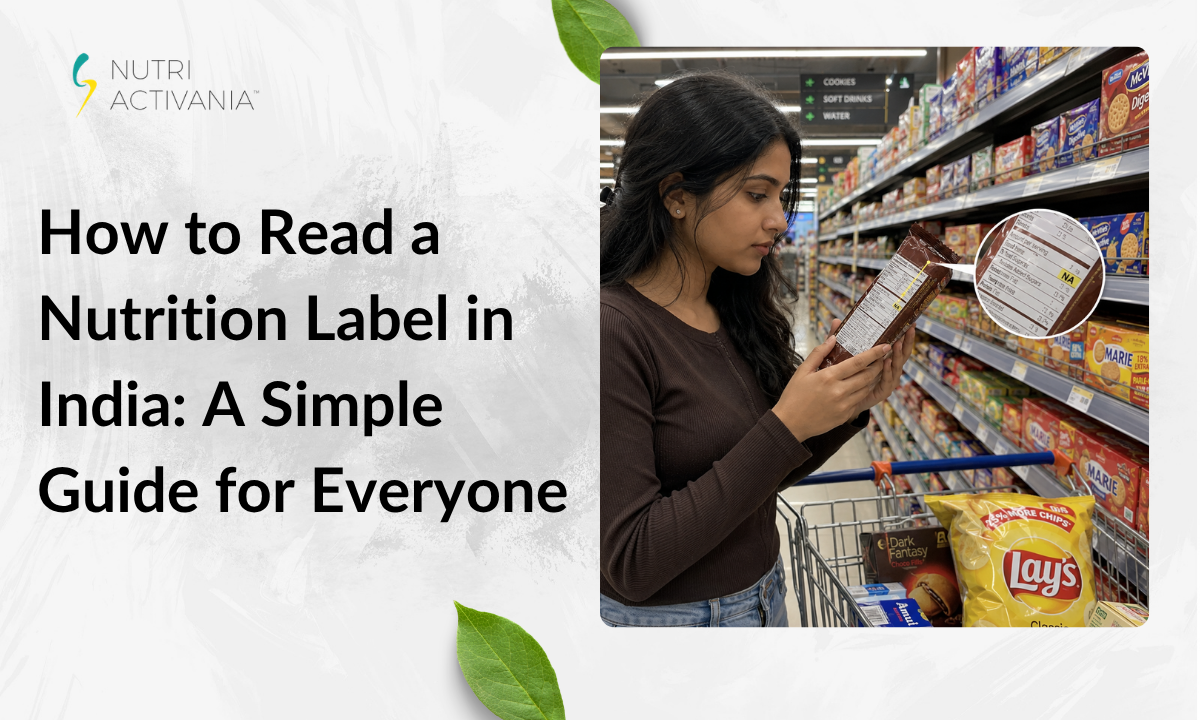
You pick up a packet of biscuits. It says “multigrain” on the front in bold green letters. Sounds healthy. You check the calories, they seem fine, and you put it in your cart.
What you probably did not check: refined wheat flour listed as the very first ingredient, followed by sugar, then palm oil. The multigrain part? A small fraction of oats added somewhere near the bottom of the list.
This is not an unusual situation. A 2014 study published in the journal Public Health Nutrition, conducted by India’s National Institute of Nutrition across Delhi and Hyderabad, found that while 90 percent of Indian consumers said they read food labels, the vast majority only checked the manufacturing and expiry date. Only one in three actually looked at the nutrition panel or ingredient list. Even among those who did, most found the information too technical to act on.
That gap between reading a label and understanding one is exactly what food companies exploit. And it costs you in ways that show up not at the checkout counter, but in your health over time.
This guide explains every part of an Indian nutrition label in plain language, what to look for, what to ignore, and the specific tricks brands use that most people fall for.
Why Reading Labels Actually Matters in India Right Now
India’s packaged food market has grown rapidly over the last decade. Urban Indians today are buying more ready-to-eat foods, instant meals, packaged snacks, health bars, and flavoured dairy products than ever before. With that growth has come an increase in products making bold front-of-pack claims: “zero sugar,” “high protein,” “natural,” “no preservatives,” “baked not fried.”
Brands have become extremely clever with these claims. A product may claim no added sugar on the front, but the nutrition table may reveal the presence of glucose syrup, malt extract, or sucralose, all of which are forms of sugar under different names. A biscuit labelled multigrain may still list refined wheat flour as the first ingredient.
With increasing urbanisation, packaged foods have become a daily reality for a growing number of Indians, which makes food label awareness not a nice-to-have skill but an essential one.
The Food Safety and Standards Authority of India, or FSSAI, regulates what must appear on packaged food labels. Knowing what FSSAI mandates, and what it does not, helps you separate what is legally required from what is voluntary marketing.
The Anatomy of an Indian Nutrition Label
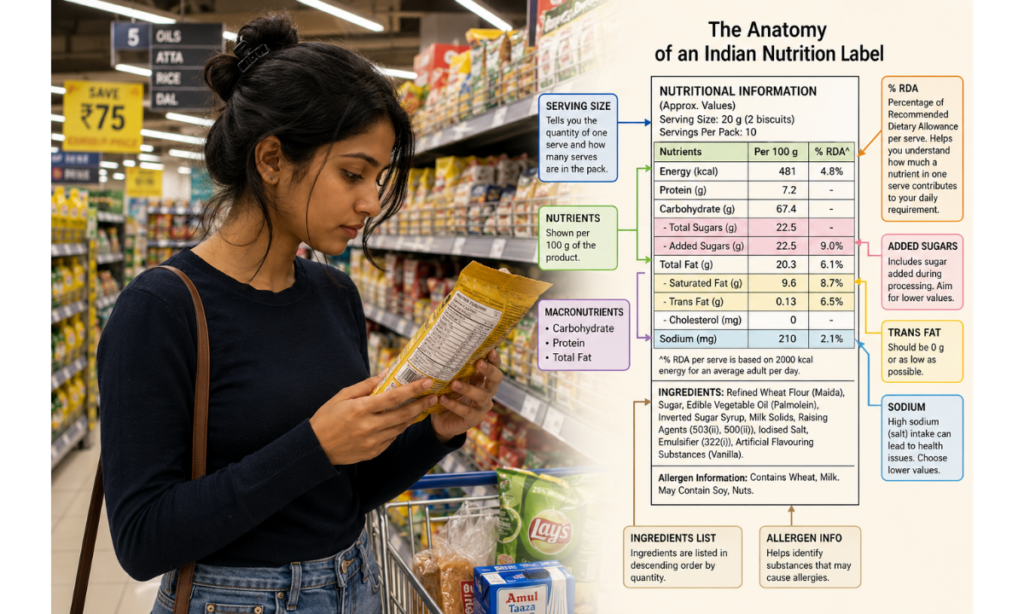
1. Serving Size: The Number That Changes Everything
The nutrition facts panel on an Indian label is based on either per 100g, per 100ml, or per serving. Many packages contain more than one serving. If a packet contains two servings and the calorie content listed is 150 calories per serving, you are actually consuming 300 calories if you eat the whole packet.
This is one of the most consistent ways people miscalculate their intake. A pack of chips that lists 180 calories per serving, with 2.5 servings in the pack, is actually 450 calories if you eat it in one sitting.
Always check serving size first, before reading any other number on the label.
2. Energy (Calories)
Calories are listed in kilocalories (kcal) on Indian labels. This represents the total energy you get from one serving of the product.
A useful rough guide:
- A snack under 150 kcal per serving is generally reasonable
- A main meal item between 300 to 500 kcal per serving is typical
- Anything above 500 kcal per serving for a snack is worth paying attention to
Calories alone do not tell you whether a food is healthy. A product can be low in calories but high in sodium, or low in fat but high in sugar. Always read across multiple rows, not just the calorie line.
3. Total Fat, Saturated Fat, and Trans Fat
Not all fats are equal, and this is where many Indian consumers stop reading too early.
- Total fat includes all types of fat in the product
- Saturated fat raises LDL cholesterol and is linked to cardiovascular disease. Indian diets already tend to be high in saturated fat from ghee, coconut oil, and dairy
- Trans fat is the most harmful. It raises bad cholesterol and lowers good cholesterol simultaneously. FSSAI mandates that trans fat content must be declared on the nutrition label, and any product with more than 0.2g of trans fat per serving is worth avoiding
Be especially cautious with vanaspati, margarine, and any product listing “partially hydrogenated vegetable oil” in the ingredients. That phrase is the ingredient-list version of trans fat.
4. Sodium: The Hidden Health Risk in Indian Packaged Food
Instant soups, ready-to-eat mixes, and packaged snacks are often marketed as light or healthy but carry very high amounts of sodium in a single serving.
Sodium is the component of salt that raises blood pressure. The World Health Organisation recommends a daily sodium intake below 2,000mg. A single serving of some popular Indian packaged soups or masala noodles can contain 800 to 1,200mg of sodium, which is more than half your daily allowance in one serving.
When reading labels, treat anything above 600mg of sodium per 100g as high. For someone managing blood pressure, diabetes, or kidney health, this number matters significantly.
5. Carbohydrates and Sugar
The carbohydrate row on an Indian label typically breaks down into total carbohydrates and sugar (both natural and added combined).
What to watch for:
- Sugar above 10g per 100g in a product that does not contain fruit is considered high
- Products labelled “no added sugar” can still contain naturally occurring sugars and sugar alcohols
- Sugar appears under many names on ingredient lists: glucose syrup, invert sugar, corn sweetener, dextran, molasses, malt syrup, maltose, and evaporated cane juice are all forms of sugar
If sugar or one of its synonyms appears in the first three ingredients, the product is high in sugar regardless of what the front label claims.
6. Protein
Protein is increasingly used as a marketing claim on Indian packaged foods. “High protein” biscuits, “protein-rich” breakfast cereals, and “extra protein” dairy drinks have multiplied on supermarket shelves.
A useful benchmark: a genuinely high-protein food should provide at least 10g of protein per 100g. Many products labelled “high protein” provide 3 to 5g per serving, which is not meaningfully different from their standard equivalents.
Always cross-check the protein claim with the actual number per serving on the nutrition panel.
How to Read the Ingredient List
The ingredient list is often more informative than the nutrition panel, and most people skip it entirely.
Ingredients are listed in descending order by quantity, from the highest to the lowest amount. The manufacturer used most of the first ingredient. This means if refined wheat flour or sugar is listed first, that is the dominant ingredient in the product regardless of what the front label says.
A practical rule: scan the first three ingredients. They make up the majority of what you are eating.
What a clean ingredient list looks like:
- Short. Fewer ingredients generally means less processing
- Recognisable. You should be able to identify most ingredients without a chemistry degree
- No ingredient high up in the list that you would not cook with at home
Red flags in ingredient lists:
- “Partially hydrogenated vegetable oil” (trans fat)
- Multiple forms of sugar listed separately (this keeps any single form lower on the list while the total sugar content remains high)
- Numbers like INS 211, INS 621 (these are preservatives and flavour enhancers; not inherently dangerous, but worth knowing what you are consuming)
- “Natural flavour” with no further specification
The Label Claims That Are Often Misleading
| Claim | What It Actually Means |
|---|---|
| “No added sugar” | No sugar was added during manufacturing. The product may still be high in natural sugars or artificial sweeteners |
| “Low fat” | Fat has been reduced, but often replaced with sugar to maintain taste. Check the sugar row |
| “Multigrain” | Contains more than one grain. Does not mean whole grain. Check if whole wheat or whole grain is listed first in ingredients |
| “Natural” | No legal definition under FSSAI for general use. Means very little without certification |
| “Baked not fried” | Reduces fat content, but does not make a product low in sodium or refined carbohydrates |
| “Zero cholesterol” | Dietary cholesterol is not the main driver of blood cholesterol for most people. A product can be zero cholesterol and still be high in saturated fat |
| “Fortified” | Fortified means essential nutrients such as vitamins and minerals have been added. This is genuinely beneficial in products like fortified atta or milk, but does not compensate for being high in sugar or sodium |
The Green Dot and Brown Dot: What They Mean
Vegetarian products in India must display a green dot symbol inside a green square, while non-vegetarian products require a brown dot symbol inside a brown square. This is a mandatory FSSAI requirement.
If a product contains only egg as its non-vegetarian ingredient, the manufacturer may add a declaration to that effect alongside the brown dot.
This system is one of the more functional parts of Indian food labelling and is generally reliable.
How to Read a Label in Under 60 Seconds
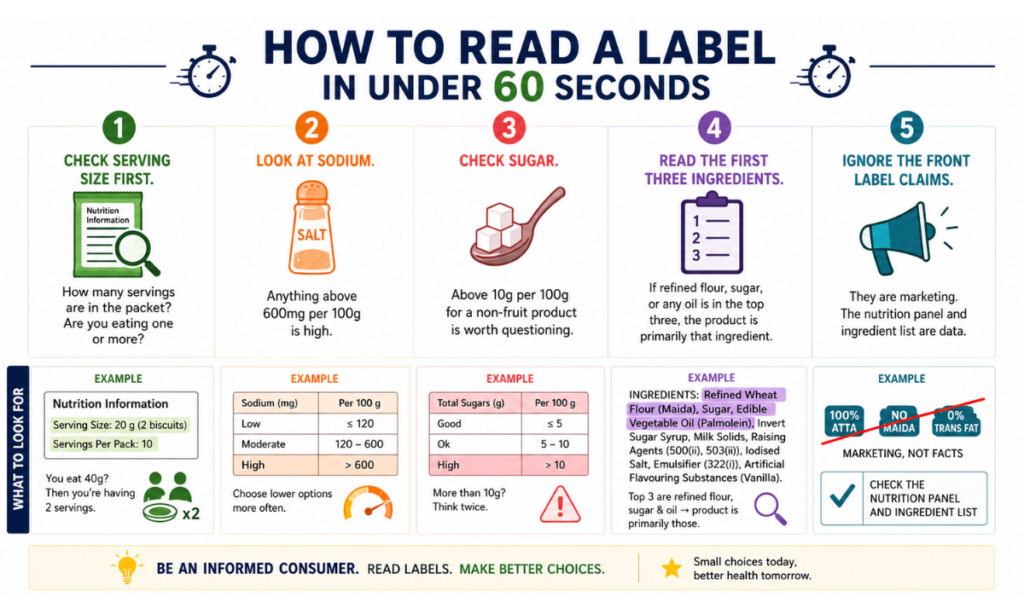
Once you understand the structure, reading a label does not need to take long. Here is a quick sequence that covers the most important ground:
- Check serving size first. How many servings are in the packet? Are you eating one or more?
- Look at sodium. Anything above 600mg per 100g is high
- Check sugar. Above 10g per 100g for a non-fruit product is worth questioning
- Read the first three ingredients. If refined flour, sugar, or any oil is in the top three, the product is primarily that ingredient
- Ignore the front label claims. They are marketing. The nutrition panel and ingredient list are data
That is it. Five steps, under a minute.
A Note on Where Nutrition Advice Fits In
Reading labels is a skill, but it is one piece of a larger picture. Knowing that a product is high in sodium does not tell you how much sodium you personally should be limiting based on your health status, age, or existing conditions.
If you are managing diabetes, hypertension, thyroid dysfunction, PCOS, or weight-related concerns, working with a qualified dietician in Delhi helps you translate general label-reading knowledge into a plan that is built around your specific clinical picture.
A credentialed clinical nutritionist and weight management specialist can also help you identify which packaged foods are genuinely acceptable for your goals and which ones, despite appearing healthy on the label, are working against them.
Conclusion
Reading a nutrition label in India is a skill the education system never taught us, but it is one of the most practically useful things you can learn for your long-term health.
The core principle is simple: do not trust the front of the pack. Read the nutrition panel, check the serving size, scan the first three ingredients, and treat claims like “natural,” “multigrain,” and “low fat” as marketing language until you verify them against actual numbers.
The more fluent you become at reading labels, the harder it becomes for misleading packaging to influence your choices.
Frequently Asked Questions
What is the most important thing to check on a nutrition label in India?
Serving size is the starting point for everything else. Many people read the calorie or sugar count without realising it applies to one serving, which is often far smaller than the amount they actually consume. Get the serving size right first, then read everything else in that context.
How do I know if a packaged food has too much sugar?
As a general guide, anything above 10g of sugar per 100g in a product that does not contain fruit is considered high. Also check the ingredient list for alternate sugar names: glucose syrup, malt extract, dextrose, invert sugar, and corn syrup are all forms of sugar and count toward total sugar content even if they are not listed as “sugar.”
What does FSSAI number on a food label mean?
The 14-digit FSSAI license number confirms that the product is manufactured or sold by a registered food business operator. Consumers can verify this number through the FSSAI portal. Its presence means the manufacturer has a valid food safety license, though it does not guarantee the nutritional quality of the product.
Is “no added sugar” the same as sugar-free?
No. “No added sugar” means no sugar was added during processing. The product may still contain significant amounts of naturally occurring sugars from ingredients like fruit concentrate, dairy, or grain. It may also contain artificial sweeteners. Always check the sugar row in the nutrition panel rather than relying on front-of-pack claims.
Should I avoid all packaged food?
Not necessarily. Packaged food is a practical reality for most urban Indian households. The goal is not elimination but informed choice. Learning to distinguish between minimally processed packaged foods with clean ingredient lists and heavily processed products with misleading claims gives you the ability to make better decisions without removing convenience entirely.
When should I consult a nutritionist about my diet?
If you are managing a health condition, trying to lose weight, dealing with fatigue or digestive issues, or simply want a structured eating plan based on your specific health goals, consulting a qualified nutrition specialist in India is a practical next step. Generic label-reading knowledge helps you shop better. A personalised nutrition plan helps you eat better in a way that is built around your body and your life.
Sources referenced:
National Institute of Nutrition, ICMR (Public Health Nutrition, 2014);
FSSAI Food Safety and Standards (Packaging and Labelling) Regulations;
Good Food Movement analysis of Indian food labelling;