
If you have been searching for the best Indian diet plan for weight loss, you have probably been given the same advice in different packaging a dozen times: eat less, avoid rice, avoid roti, cut ghee, do intermittent fasting, try keto. None of these work long-term for Indians, because they ignore the single most important fact about Indian weight loss: a sustainable diet plan has to include Indian food. Not Indian-themed substitutes, not “healthy” replacements. The actual roti, rice, dal, sabzi, curd, and ghee you grew up on, in portions and combinations that cause fat loss instead of weight gain.
This pillar page is the complete, consolidated Indian diet plan for weight loss resource from Nutri Activania, led by Avni Kaul, Gold Medalist in Food and Nutrition from Lady Irwin College and recognised as Best Nutritionist in India 2018-19.
Why Most Indian Diet Plans Fail for Weight Loss
Most Indian weight loss diets collapse within 3 to 6 weeks for the same reasons.
Reason 1: They eliminate entire food groups
“Avoid rice.” “Avoid roti.” “Avoid ghee.” “Avoid fruit after 6 pm.” These rules fight against a lifetime of eating habits and a shared family kitchen. They never survive past a few weeks.
Reason 2: Calorie targets are set too low
Most downloaded Indian diet charts sit between 800 and 1,200 calories. At that intake, the body enters starvation mode, metabolism slows, muscle is lost, and the moment you return to normal eating, weight returns with interest.
Reason 3: Protein is drastically underserved
A typical Indian weight loss chart delivers 40 to 60g of protein daily. For sustainable fat loss while preserving muscle, most adults need 1 to 1.2g per kg body weight, which is 60 to 90g for most women and 80 to 120g for most men.
Reason 4: No account for family cooking
A single diet chart ignores that the whole family cooks together. Separate cooking for one person is not realistic in most Indian households.
Reason 5: No follow-up structure
Diet charts are handed out and forgotten. Real weight loss requires weekly or fortnightly adjustment based on how your body responds.
Reason 6: Ignores medical reality
PCOS, thyroid, insulin resistance, fatty liver, and cholesterol all affect weight loss. A generic plan ignores all of them.
Reason 7: No lifestyle fit
Working professionals, mothers, senior citizens, and teenagers all have different schedules, sleep patterns, and stress levels. One template cannot work across all of them.
A real Indian weight loss diet plan solves for every one of these. Avni Kaul’s approach does. See the full weight loss dietician in Delhi programme for how it works in practice.
Core Principles of a Real Indian Weight Loss Diet
Every effective Indian weight loss diet is built on the same ten principles. These apply whether you are vegetarian or non-vegetarian, from North or South India, and regardless of your medical condition.
Principle 1: Protein at every meal
Target 1 to 1.2g per kg of body weight per day. Protein sources: dal, paneer, tofu, curd, eggs, chicken, fish, soya chunks, sprouts, chickpeas, rajma, moong.
Principle 2: Carb quality over carb elimination
Carbs stay in the plan, but shift toward complex, low-GI options: jowar, bajra, ragi, foxtail millet, oats, quinoa, brown rice. White rice and maida are reduced, not eliminated.
Principle 3: Fibre volume from vegetables
Minimum 5 servings of vegetables daily. Leafy greens, non-starchy vegetables, salads, soups. Fibre keeps you full, feeds gut bacteria, and slows carb absorption.
Principle 4: Healthy fats in appropriate portions
Ghee (2 to 3 teaspoons daily), mustard oil, cold-pressed coconut oil, olive oil for salads, nuts and seeds. Fat is not the enemy. Fat excess is.
Principle 5: Sugar restriction, not elimination
Refined sugar, packaged sweets, sweetened drinks, and biscuits are limited. Natural sugars from fruit and occasional mithai in small portions are fine.
Principle 6: Hydration priority
3 litres of water daily. Herbal teas, buttermilk, nimbu pani, infused water all count. Aerated drinks, sweetened lassi, and packaged juices do not.
Principle 7: Meal timing structure
Breakfast within 90 minutes of waking, meals 3 to 4 hours apart, dinner 2 to 3 hours before sleep. No long fasting gaps that spike cortisol.
Principle 8: Portion control, not deprivation
Nothing is banned. Portions of calorie-dense foods are measured. Portions of low-density foods (vegetables, salads) are unrestricted.
Principle 9: Flexibility for social events
Weddings, festivals, parties, and restaurant dinners are built into the plan, not wished away. The next-day correction matters more than the one meal.
Principle 10: Lifestyle support
Sleep, stress, movement, and hydration all affect weight loss. Food alone is not enough.
Foods to Eat and Foods to Limit
Indian foods to eat
1. Grains: Jowar, bajra, ragi, foxtail millet, little millet, oats, quinoa, multi-grain atta, brown rice, hand-pounded rice.
2. Dals and legumes: Moong, masoor, arhar, chana, rajma, chickpeas, black-eyed peas, horse gram, sprouts.
3. Protein: Paneer, tofu, curd, eggs, chicken breast, fish (rohu, surmai, tilapia), soya chunks.
4. Vegetables: Palak, methi, bathua, sarson, cabbage, cauliflower, bhindi, lauki, tinda, pumpkin, gourd, beans, carrots, capsicum, tomato, cucumber, radish.
5. Fruits: Apple, pear, orange, guava, papaya, berries, pomegranate, watermelon, musk melon (portion controlled), seasonal fruits.
6. Fats: Ghee (measured), mustard oil, cold-pressed coconut oil, olive oil for salads.
7. Nuts and seeds: Almonds, walnuts, pistachios, pumpkin seeds, flaxseeds, chia seeds, sunflower seeds.
8. Dairy: Curd, buttermilk, paneer, milk in moderation (toned or double-toned).
9. Spices and functional foods: Turmeric, methi, ginger, garlic, cinnamon, black pepper, jeera, ajwain, saunf.
10. Beverages: Water, green tea, herbal tea, nimbu pani, buttermilk with jeera, infused water.
Indian foods to limit
1. Grains and starch: White rice (in large portions), maida, refined flour products, white bread, pasta.
2. Sugar: Refined sugar, jaggery in excess, honey in excess, mithai, cakes, pastries, ice cream, sweetened yoghurt.
3. Fried foods: Samosa, pakora, kachori, fried snacks, deep-fried bhujia.
4. Processed foods: Packaged namkeen, chips, biscuits, cookies, instant noodles, ready meals.
5. Beverages: Aerated drinks, packaged juices, sweetened lassi, sweetened coffee and tea with excess sugar.
6. Unhealthy fats: Vanaspati, repeatedly heated oils, excess ghee beyond 2 to 3 teaspoons daily.
7. Alcohol: Not recommended during active weight loss. Occasional restriction-free weekends can include small portions.
7-Day Vegetarian Indian Diet Plan for Weight Loss
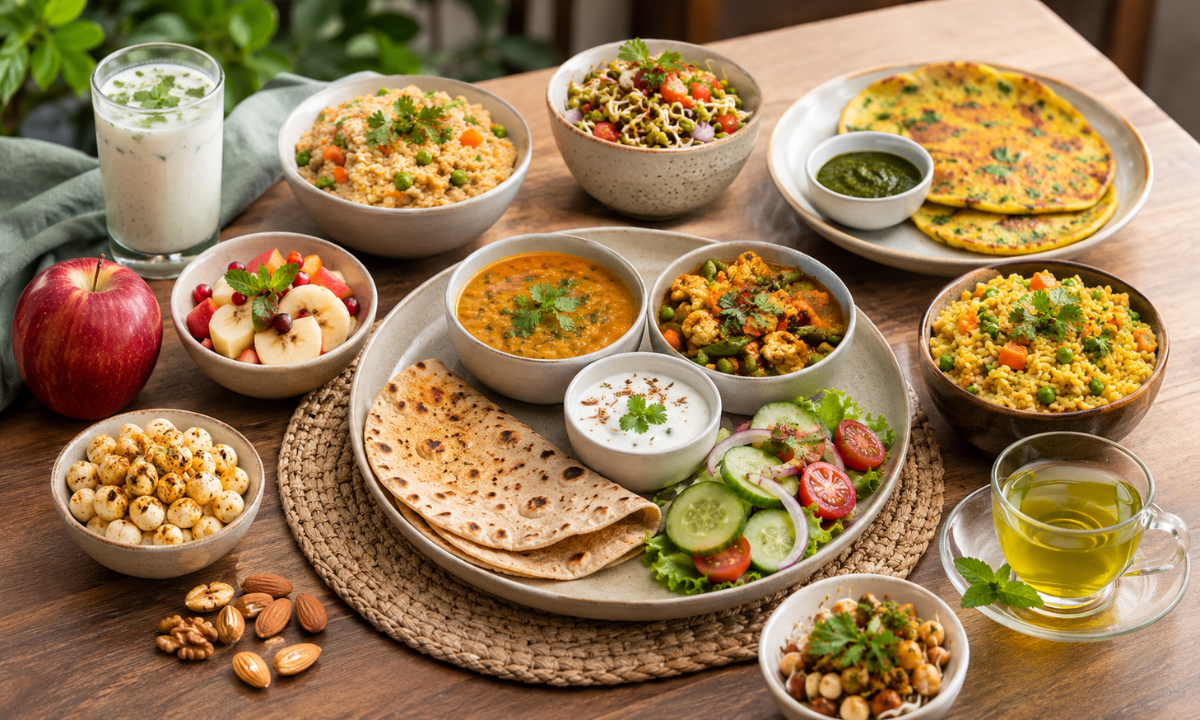
A sample 7-day vegetarian diet for a woman with moderate activity, targeting 1,500 to 1,600 calories. Portion sizes are illustrative. For your personalised plan, book a consultation.
Daily morning routine (every day)
- Wake-up: warm water with lemon + soaked methi seeds
- 5 to 7 soaked almonds and 2 walnuts
Day 1 (Monday)
| Meal | Options |
|---|---|
| Breakfast | 1 bowl vegetable oats upma + 1 small bowl curd |
| Mid-morning | 1 apple + 1 glass buttermilk |
| Lunch | 1 bowl moong dal + 1 bowl mixed vegetable sabzi + 2 multi-grain roti + salad + 1 small bowl curd |
| Evening | Green tea + 1 bowl sprouts chaat |
| Dinner | 1 bowl vegetable soup + 1 bowl paneer bhurji + 1 bajra roti + salad |
Day 2 (Tuesday)
| Meal | Options |
|---|---|
| Breakfast | 2 besan cheela with mint chutney + 1 small bowl curd |
| Mid-morning | 1 pear + 5 roasted chana |
| Lunch | 1 bowl masoor dal + 1 bowl bhindi sabzi + 2 jowar roti + salad |
| Evening | Herbal tea + 2 khakra + hummus |
| Dinner | 1 bowl mixed dal khichdi with vegetables + 1 small bowl curd |
Day 3 (Wednesday)
| Meal | Options |
|---|---|
| Breakfast | 2 egg white and vegetable omelette OR 2 vegetable idli with sambar |
| Mid-morning | 1 orange + 2 walnuts |
| Lunch | 1 bowl rajma + 1 small bowl brown rice + 1 bowl cucumber salad + 1 small bowl curd |
| Evening | Green tea + 1 bowl roasted makhana |
| Dinner | 1 bowl tofu stir-fry + 1 multi-grain roti + salad |
Day 4 (Thursday)
| Meal | Options |
|---|---|
| Breakfast | 1 bowl vegetable poha with peanuts + 1 glass buttermilk |
| Mid-morning | 1 guava + 5 roasted chana |
| Lunch | 1 bowl chana dal + 1 bowl lauki sabzi + 2 bajra roti + salad |
| Evening | Herbal tea + 1 small bowl fruit chaat |
| Dinner | 1 bowl paneer and vegetable curry (minimal oil) + 1 ragi roti + salad |
Day 5 (Friday)
| Meal | Options |
|---|---|
| Breakfast | 1 bowl ragi dosa with vegetable stuffing + coconut chutney (minimal) |
| Mid-morning | 1 apple + 1 glass buttermilk |
| Lunch | 1 bowl arhar dal + 1 bowl palak paneer (light) + 2 jowar roti + salad |
| Evening | Green tea + 2 vegetable dhokla |
| Dinner | 1 bowl mixed vegetable soup + 1 bowl soya chunks curry + 1 multi-grain roti |
Day 6 (Saturday)
| Meal | Options |
|---|---|
| Breakfast | 2 moong dal cheela with mint chutney + 1 small bowl curd |
| Mid-morning | 1 pear + 2 walnuts |
| Lunch | 1 bowl kadhi + 1 small bowl brown rice + 1 bowl salad + 1 bowl green sabzi |
| Evening | Herbal tea + 1 bowl sprouts chaat |
| Dinner | 1 bowl vegetable khichdi with dahi + salad |
Day 7 (Sunday, flexibility day)
| Meal | Options |
|---|---|
| Breakfast | 1 bowl vegetable upma OR 2 idli with sambar |
| Mid-morning | 1 fruit + 5 roasted chana |
| Lunch | Social meal (restaurant or family lunch) with portion awareness |
| Evening | Green tea + 1 small bowl roasted makhana |
| Dinner | 1 bowl light dal + 1 bowl mixed sabzi + 1 multi-grain roti + salad |
For a vegetarian-specific deep dive, see the vegetarian meal plan for weight loss.
7-Day Non-Vegetarian Indian Diet Plan for Weight Loss
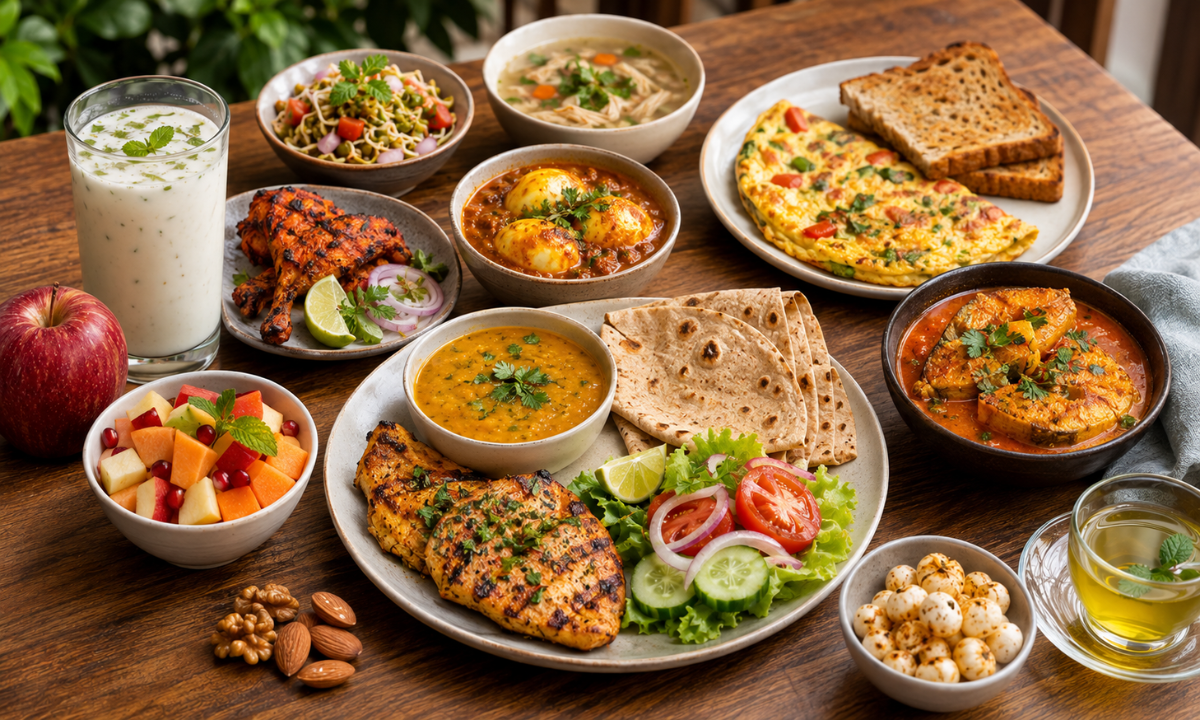
A sample 7-day non-vegetarian diet for a man with moderate activity, targeting 1,700 to 1,800 calories.
Daily morning routine (every day)
- Wake-up: warm water with lemon + soaked methi seeds
- 5 to 7 soaked almonds and 2 walnuts
Day 1 (Monday)
| Meal | Options |
|---|---|
| Breakfast | 3 egg white + 1 whole egg omelette with vegetables + 1 multi-grain toast |
| Mid-morning | 1 apple + 1 glass buttermilk |
| Lunch | Grilled chicken breast (150g) + 1 bowl dal + 1 bowl mixed sabzi + 2 jowar roti + salad |
| Evening | Green tea + 1 bowl sprouts chaat |
| Dinner | 1 bowl fish curry (150g rohu or surmai) + 1 bowl sabzi + 1 bajra roti + salad |
Day 2 (Tuesday)
| Meal | Options |
|---|---|
| Breakfast | 2 boiled eggs + 1 bowl vegetable oats upma |
| Mid-morning | 1 pear + 5 roasted chana |
| Lunch | 1 bowl chicken curry (150g, minimal oil) + 2 multi-grain roti + 1 bowl mixed sabzi + salad |
| Evening | Herbal tea + 2 boiled eggs OR 1 bowl hummus with carrot sticks |
| Dinner | 1 bowl grilled fish (150g) + 1 bowl vegetable soup + salad + 1 small multi-grain roti |
Day 3 (Wednesday)
| Meal | Options |
|---|---|
| Breakfast | 1 vegetable omelette (2 eggs) + 1 multi-grain toast |
| Mid-morning | 1 orange + 2 walnuts |
| Lunch | 1 bowl egg curry (2 eggs) + 1 bowl dal + 2 jowar roti + salad |
| Evening | Green tea + 1 bowl roasted makhana |
| Dinner | 1 bowl chicken soup + 1 bowl stir-fried vegetables with paneer + 1 multi-grain roti |
Day 4 (Thursday)
| Meal | Options |
|---|---|
| Breakfast | Egg bhurji with onions and tomatoes + 1 multi-grain toast |
| Mid-morning | 1 guava + 5 roasted chana |
| Lunch | Grilled fish (150g) + 1 small bowl brown rice + 1 bowl dal + 1 bowl salad |
| Evening | Herbal tea + 1 small bowl fruit chaat |
| Dinner | 1 bowl tandoori chicken (150g, without skin) + 1 bowl mixed sabzi + 1 ragi roti |
Day 5 (Friday)
| Meal | Options |
|---|---|
| Breakfast | 3 egg white scramble + 1 multi-grain toast + 1 glass buttermilk |
| Mid-morning | 1 apple + 2 walnuts |
| Lunch | 1 bowl chicken sabzi (150g) + 2 jowar roti + 1 bowl salad + 1 small bowl curd |
| Evening | Green tea + 2 boiled eggs |
| Dinner | 1 bowl fish curry (150g) + 1 bowl mixed vegetable sabzi + 1 bajra roti |
Day 6 (Saturday)
| Meal | Options |
|---|---|
| Breakfast | 2 egg omelette + 1 bowl vegetable poha |
| Mid-morning | 1 pear + 2 walnuts |
| Lunch | 1 bowl keema (150g, minimal oil) + 2 multi-grain roti + 1 bowl salad |
| Evening | Herbal tea + 1 bowl sprouts chaat |
| Dinner | 1 bowl grilled chicken (150g) + 1 bowl mixed vegetable soup + salad |
Day 7 (Sunday, flexibility day)
| Meal | Options |
|---|---|
| Breakfast | 3 egg omelette OR 2 boiled eggs with 1 multi-grain toast |
| Mid-morning | 1 fruit + 5 roasted chana |
| Lunch | Social meal (restaurant or family lunch) with portion awareness |
| Evening | Green tea + 1 small bowl roasted makhana |
| Dinner | 1 bowl light dal + 1 bowl grilled fish or chicken (150g) + salad + 1 multi-grain roti |
For the full Indian diet plan with diet charts and portion guidance, see Indian diet plan for weight loss with diet charts.
Regional Variations
Indian cuisine is not one cuisine. A real weight loss plan respects where you grew up and what your kitchen cooks naturally. Below are region-specific adjustments to the core framework.
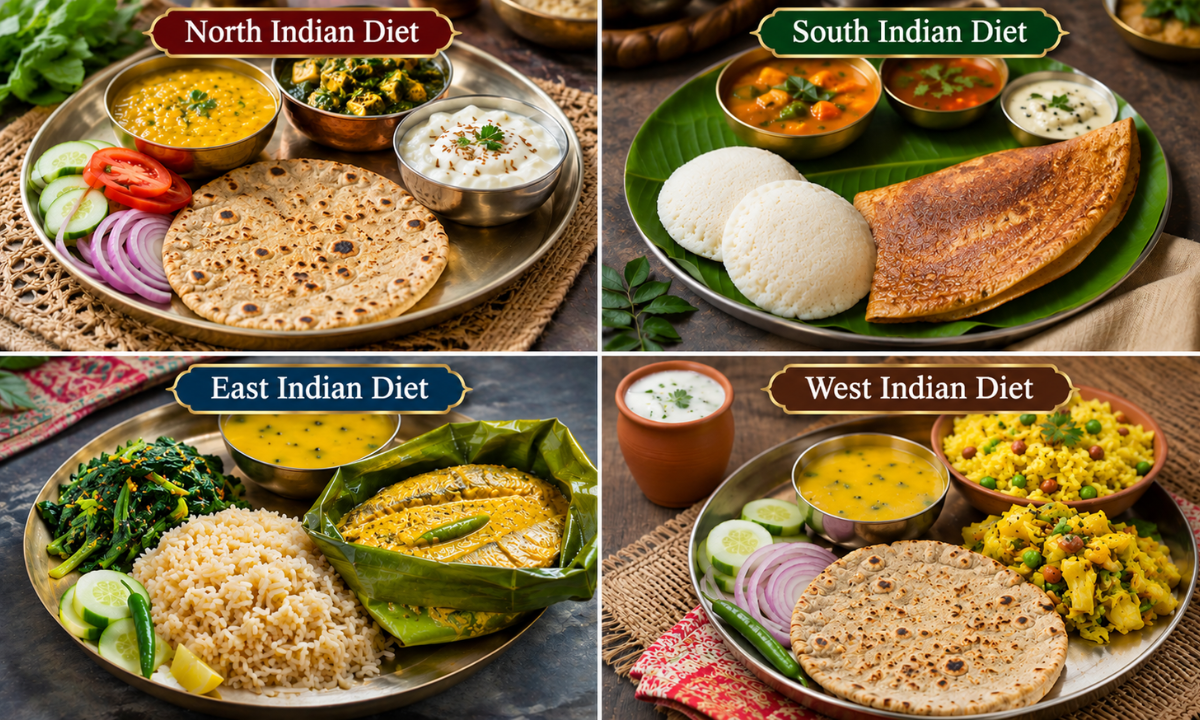
North Indian weight loss diet
Staples retained: jowar, bajra, ragi, multi-grain atta, dal, paneer, curd, sarson, methi, palak.
Portion-controlled: ghee, white rice, maida parathas, fried snacks, mithai.
Key swaps: jowar or bajra roti in place of maida parathas 4 to 5 days a week; curd instead of sweetened lassi; grilled tandoori chicken or paneer tikka instead of butter chicken or shahi paneer.
South Indian weight loss diet
Staples retained: ragi, foxtail millet, idli, dosa, sambar, rasam, curd rice, vegetables.
Portion-controlled: white rice, coconut chutney, ghee, vada, fried sides.
Key swaps: ragi dosa or oats idli 3 to 4 days a week; small portion of brown rice for curd rice; sambar and rasam prioritised over coconut-heavy curries.
East Indian weight loss diet
Staples retained: fish, mustard oil, posto (minimal), dal, vegetables, mustard greens, luchi replaced with roti.
Portion-controlled: luchi, mishti doi, roshogolla, fried snacks.
Key swaps: grilled or steamed fish (bhapa) over fried fish; small portion of brown rice; mishti limited to small portions once or twice a week.
West Indian weight loss diet
Staples retained: jowar bhakri, dal, varan, vegetables, buttermilk, poha, thepla (multi-grain version).
Portion-controlled: puran poli, farsan, fried snacks, sweetened chaas, ghee on bhakri.
Key swaps: jowar or bajra bhakri as default grain; vegetable poha or oats upma for breakfast; buttermilk over sweetened lassi.
Indian Diet Plan for PCOS Weight Loss
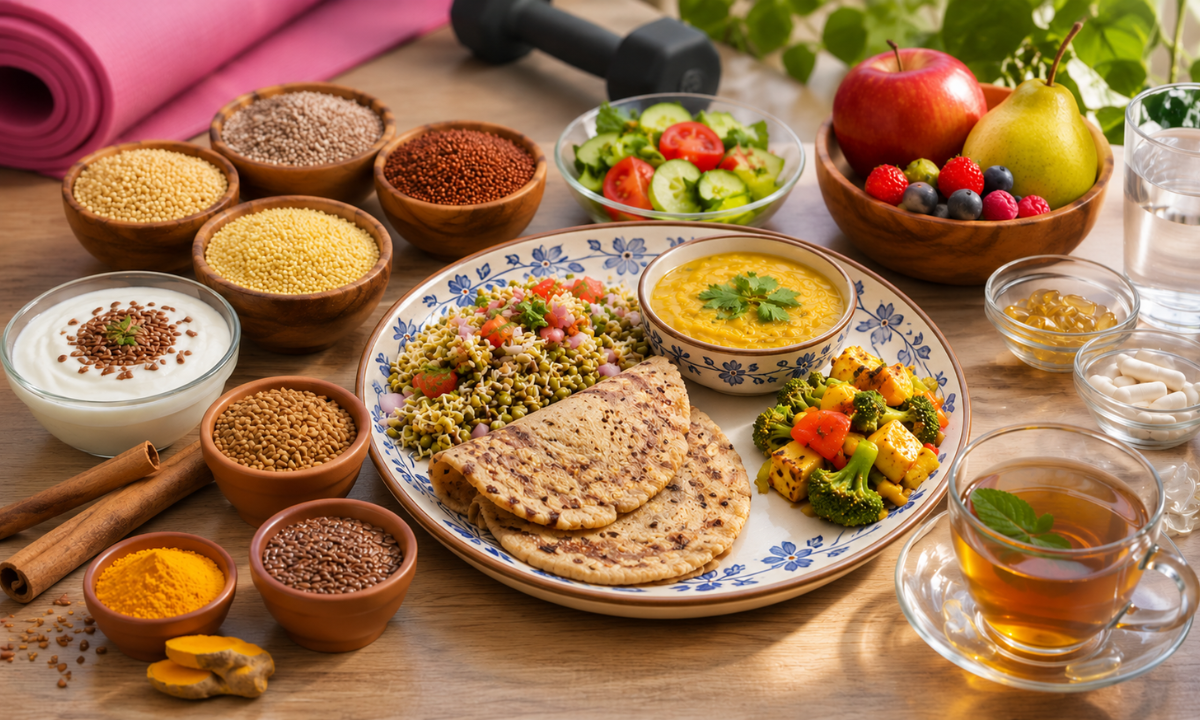
PCOS weight loss is not the same as general weight loss. It is driven by insulin resistance, hormonal imbalance, and inflammation, and requires a different approach.
PCOS-specific adjustments
- Carbs: stricter focus on low-GI (jowar, bajra, ragi, foxtail millet); white rice and maida sharply reduced
- Protein: 1.2 to 1.6g per kg body weight, higher than general weight loss targets
- Meal timing: no long fasting gaps; meals every 3 to 4 hours to stabilise insulin
- Functional foods: methi seeds, cinnamon, turmeric, flaxseed daily
- Supplements where needed: inositol, vitamin D, B12, omega-3 (based on blood work)
- Dairy: reviewed case by case, reduced if symptoms are not improving
- Fruit: low-GI fruits prioritised (apple, pear, berries), bananas and grapes reduced
For the full PCOS diet programme, see best dietician for PCOS in India and dietician for PCOS in Delhi.
Indian Diet Plan for Thyroid Weight Loss
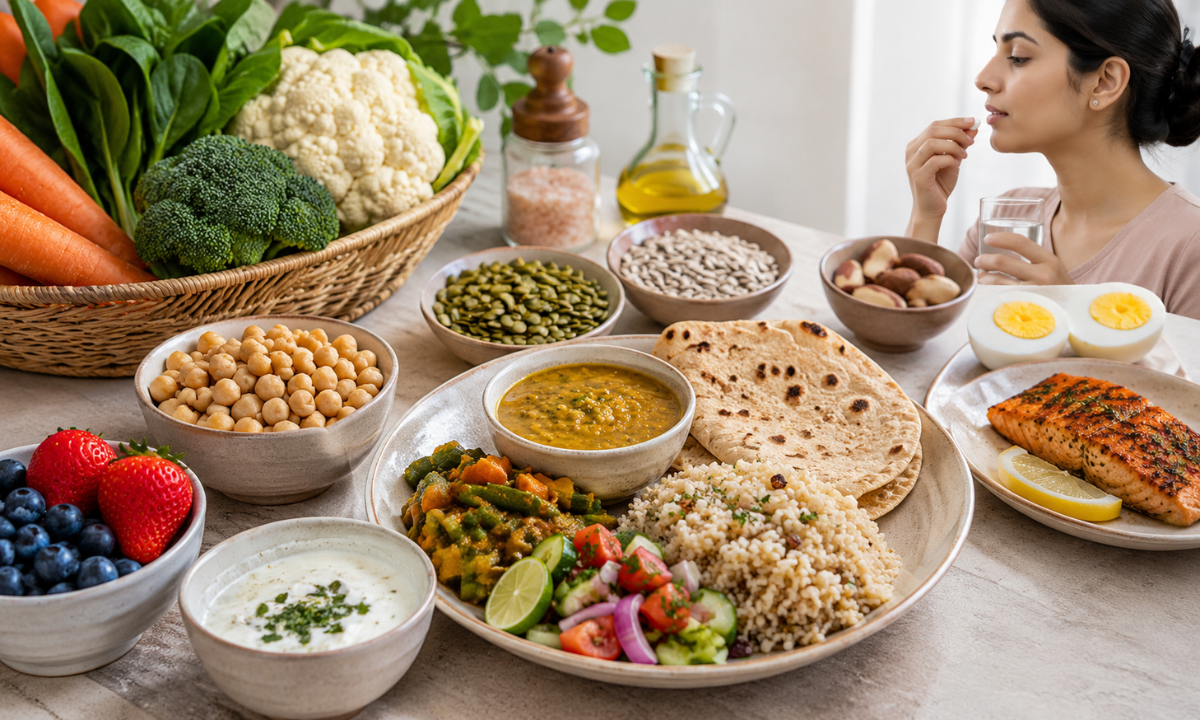
Thyroid patients (particularly hypothyroid) have specific dietary needs that affect weight loss.
Thyroid-specific adjustments
- Iodine: adequate but not excessive (iodised salt in moderation)
- Selenium: brazil nuts, eggs, fish, sunflower seeds
- Zinc: pumpkin seeds, chickpeas, lentils
- Iron and B12: often low in hypothyroid patients, supplementation reviewed
- Goitrogens: raw cruciferous vegetables (cabbage, cauliflower, broccoli) limited; cooked is fine
- Soy: limited, as it can interfere with thyroid medication absorption
- Gluten: reviewed if autoimmune (Hashimoto’s) involvement is suspected
- Medication timing: thyroid medication should be taken on empty stomach, 30 to 60 minutes before food or caffeine
For thyroid-aware weight loss, see dietician for thyroid in Delhi.
Indian Diet Plan for Diabetes Weight Loss
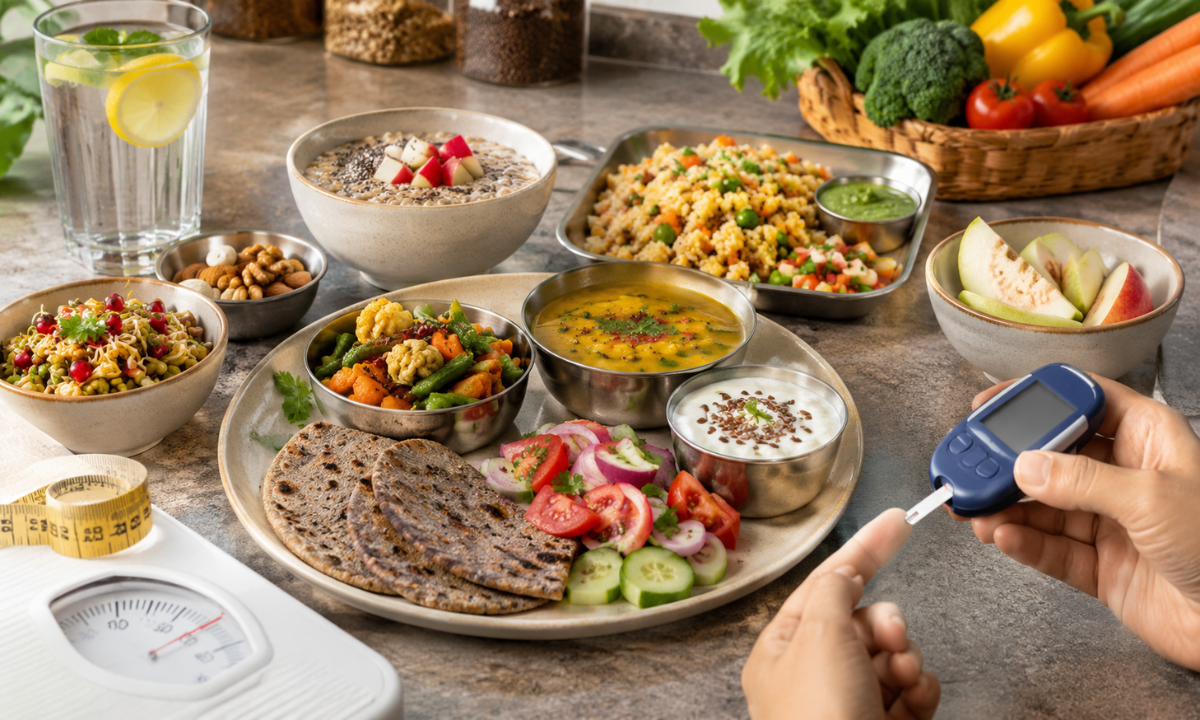
Diabetes and pre-diabetes weight loss requires tight blood sugar control alongside fat loss.
Diabetes-specific adjustments
- Carb portions: measured precisely; preference for low-GI jowar, bajra, ragi
- Carb sequencing: protein and fibre first, carbs last in each meal
- Meal spacing: regular 3 to 4 hour intervals to prevent blood sugar spikes
- Fruit: small portions, with meals rather than between, low-GI options prioritised
- Dal, vegetables, protein at every meal: non-negotiable
- Sugar and sweeteners: refined sugar eliminated; artificial sweeteners used sparingly
- Monitoring: HbA1c, fasting sugar, post-meal sugar tracked alongside weight
- Medication coordination: plan designed to complement medication; dosage reviews with endocrinologist as markers improve
For diabetes weight management, see dietician for diabetes in Delhi.
Indian Diet Plan for Fatty Liver Weight Loss
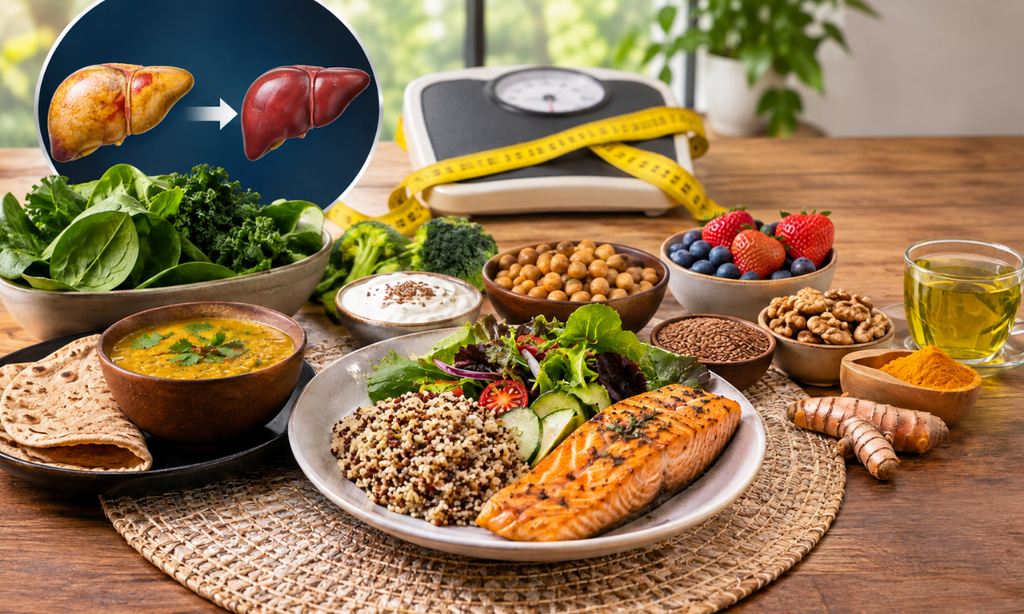
Fatty liver (NAFLD) responds well to targeted nutrition and weight loss.
Fatty-liver-specific adjustments
- Sugar elimination: refined sugar, fructose from juices, sweetened drinks all cut
- Carb quality: complex carbs only; refined carbs minimised
- Protein priority: lean protein at every meal
- Healthy fats: omega-3 from fatty fish, flaxseed, walnuts
- Alcohol: avoided entirely during fatty liver management
- Antioxidant-rich foods: leafy greens, berries, turmeric, green tea
- Weight loss target: 7 to 10% body weight loss over 6 to 12 months is the clinical target for fatty liver improvement
- Monitoring: LFT, ultrasound, and FibroScan tracked alongside weight
For fatty liver nutrition support, see dietician for fatty liver in Delhi.
Common Mistakes to Avoid
The most common mistakes that stall or reverse Indian weight loss progress:
- Skipping breakfast. Long morning fasting drives cortisol and afternoon binge eating.
- Treating liquid calories as free. Chai with sugar, juices, sweetened lassi, protein shakes with added sugar all count.
- Over-relying on salads without protein. A salad without 20 to 30g of protein is a snack, not a meal.
- Cutting fat entirely. Fat-free diets backfire. Fat is required for hormone production and satiety.
- Ignoring sleep. Less than 6 hours of sleep is directly linked to abdominal fat gain.
- Weighing daily and panicking. Weight fluctuates 1 to 2 kg day to day based on water, salt, and hormones. Weekly tracking is more useful.
- Eating “healthy” packaged food. Granola bars, protein bars, flavoured yoghurt, and packaged “diet” snacks are often loaded with sugar.
- Following someone else’s diet. A plan that worked for your friend or your colleague is not your plan.
- Extreme weekend “cheating.” One restrictive week undone by a cheat weekend produces zero progress.
- No follow-up or adjustment. The body adapts. A plan that worked in month 1 needs adjustment by month 3.
How to Personalise the Plan
The templates above are starting points, not prescriptions. Your actual plan should be adjusted for:
- Your current weight, target weight, and medical history
- Your blood work (HbA1c, fasting insulin, thyroid, vitamin D, B12, lipid profile, liver function)
- Your activity level (sedentary, moderate, active)
- Your medications
- Your food preferences and cultural eating patterns
- Your work schedule and sleep pattern
- Your family cooking patterns
- Your social and travel calendar
A personalised Indian weight loss plan accounts for all of the above. For a fully customised plan reviewed and adjusted weekly or fortnightly, book a consultation with Avni Kaul.
For in-person consultations in Delhi, visit the Saket clinic. For patients outside Delhi, full online consultations are available across India and abroad.
Individual results vary with any personalised diet plan or nutrition counselling programme. Outcomes depend on your health status, adherence to the plan, activity level, medications and other individual factors.
Conclusion
The best Indian diet plan for weight loss is not a copy-paste chart from the internet. It is a sustainable, protein-prioritised, low-GI, Indian-food-first eating structure built around your medical history, lifestyle, and preferences. Roti, rice, dal, paneer, ghee, and curd all stay in the plan. What changes is portion sizes, grain quality, protein priority, meal timing, and the systematic cut of ultra-processed food and refined sugar. Avni Kaul’s 12+ years of clinical nutrition experience have produced sustained weight loss for hundreds of Indian patients across weight categories, medical conditions, and life stages. Book a consultation to build a plan specifically for you.
Frequently Asked Questions
Can I follow an Indian diet plan and still lose weight?
Yes. In fact, an Indian diet based on jowar, bajra, ragi, dal, vegetables, and lean protein is among the most sustainable weight loss diets in the world. Restriction of refined grains and sugar is what matters, not elimination of Indian food.
How much weight can I lose in a month with an Indian weight loss diet plan?
Realistic sustainable loss is 2 to 4 kg per month for women and 3 to 5 kg per month for men, depending on starting weight, medical conditions, and adherence.
Do I have to give up rice?
No. Rice stays in the plan in appropriate portions. Brown rice or hand-pounded rice is preferred, but small portions of white rice are also fine. The key is portion and what sits alongside it.
Do I have to give up roti?
No. Roti stays in the plan. Multi-grain atta, jowar, bajra, and ragi rotis rotate through the week. Portion sizes are controlled.
Can I eat ghee during weight loss?
Yes. 2 to 3 teaspoons of ghee per day is beneficial, not harmful, for most adults during weight loss. Excess is where the problem starts.
How much protein should I eat daily?
Target 1 to 1.2g per kg body weight for general weight loss. 1.2 to 1.6g per kg for PCOS or higher-intensity training. This is more than most Indian diets deliver, and is the single biggest adjustment most patients need to make.
Is intermittent fasting good for Indian weight loss?
For some people, yes. For others (especially women with PCOS, hormonal issues, or high stress), no. It should not be the default recommendation. The right eating window depends on your individual physiology.
What is the best Indian diet plan for PCOS weight loss?
A low-GI, protein-prioritised, insulin-sensitising Indian plan with methi, cinnamon, flaxseed, and inositol-supporting foods, designed around regular meal timing. See the PCOS-specific page.
What is the best Indian diet plan for thyroid weight loss?
A plan with adequate selenium, zinc, iron, and B12; limited raw goitrogens and soy; and medication-aware timing. See the thyroid dietician page.
What is the best Indian diet plan for diabetes weight loss?
A low-GI, carb-controlled, protein-first plan with meal spacing to prevent blood sugar spikes. See the diabetes dietician page.
What is the best Indian diet plan for fatty liver weight loss?
A sugar-free, complex-carb, lean-protein, antioxidant-rich plan aimed at 7 to 10% body weight loss over 6 to 12 months. See the fatty liver dietician page.
Can I follow this diet while working long hours?
Yes. Pre-portioned tiffins, pantry-friendly snacks, and realistic late-dinner options are built into all professional plans. See weight loss for working professionals.
What about non-vegetarian Indian weight loss?
Fully supported. Eggs, chicken, fish, and lean meat all feature in the plan. Grilled, baked, or lightly curried preparations are preferred over deep-fried.
Can I follow this plan if I live in a joint family?
Yes. The plan is designed to work with shared family cooking through portion control, small additions on your plate, and smart grain swaps at specific meals.
How long will it take to see results?
Energy, sleep, and bloating usually improve in the first week. Visible weight and measurement changes typically show by week 3 to 4. Significant transformation typically needs 3 to 6 months.
Do I need supplements?
Only where blood work indicates deficiency. Common supplements that may be recommended: vitamin D, B12, omega-3, iron, magnesium, inositol (for PCOS). Not everyone needs them.
What about Indian festivals and weddings?
Built into the plan. Specific strategies for Diwali, Karva Chauth, Holi, wedding season, and Eid are included for patients following the full programme. The goal is enjoyment with portion awareness, followed by next-day correction.
Can I follow this plan if I am over 40 or 50?
Yes. Plans are adjusted for metabolism, muscle preservation, calcium, vitamin D, and iron needs specific to this age group.
Can teenagers follow this plan?
Only with parental involvement and consultation. Teen plans are age-adjusted and growth-friendly, not aggressive calorie restriction.
Can I follow this plan online from outside Delhi?
Yes. Online consultations and plan delivery are available across India and internationally. See online dietitian consultation.