
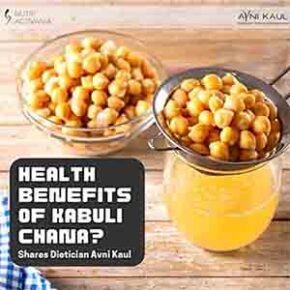
When one talks of versatile foods, chickpeas or Kabuli Chana might not be the first thing that comes to your mind. However, this plant-based food packs a rich nutritional wallop and adds flavor to multiple savory dishes. Delhi’s leading Dietician Avni Kaul explains why Kabuli Chanas are so good for you — and the specific health benefits they provide through this blog.
What are chickpeas (Kabuli Chana)

Chickpeas, which are also referred to as the garbanzo bean or in the Indian context Kabuli Chana, are classified as a legume. They come from a plant — in fact, they are one of the earliest cultivated food products in human history — and grow two to three to a pod. However, chickpeas are considered to be both a vegetable and a protein since they are very nutritious. Some people even consider them a superfood.
Why chickpeas are so healthy
Chickpeas are a complete protein since they contain all nine essential amino acids, which are building blocks that support our body’s functions properly. “Chickpeas are also a great source of non-animal protein. Thus, they are great for vegetarians and vegans.
Chickpeas are also full of vitamins and minerals. These include choline, which helps your brain and nervous system function smoothly, as well as magnesium, potassium, folate, and iron. For good measure, chickpeas are also rich in vitamin A, E, and C. This is why they reap lots of health benefits. These tiny peas are simply packed with nutrition.
The health benefits of chickpeas (Kabuli Chana)
There are numerous health benefits that chickpeas have to offer. Here are some of those.
Promotes weight loss
Chickpeas are a good source of fiber. In fact, a single cup serving represents “roughly almost half of the recommended daily fiber intake for adults. It promotes satiety (in simple words, it helps you feel full longer) so you do not overeat. This could help people reduce weight if they are trying to do so, or maintain their weight.
Source: https : //pubmed.ncbi.nlm.nih.gov/28303049/
Good for cardiovascular health
Chickpeas are naturally low in sodium and are cholesterol-free. They are also a good source of polyunsaturated fats which help control (and lower) your cholesterol levels and this reduces your risk of developing heart disease.
Source: https //www.ncbi.nlm.nih.gov/pmc/articles/PMC4016088/
It helps in preventing constipation
Since these are high in fiber, they also help prevent constipation which keeps your gastrointestinal (gut) health in perfect shape.
Helps control blood sugar
Chickpeas are low on the glycemic index, which means that they do not make your blood sugar spike. This is, therefore, good food to incorporate into your meal if you have trouble regulating your blood sugar.
Serve a great alternative for anyone having gluten sensitivity
People living with celiac disease form a sensitivity to gluten, which could make their dietary choices difficult. Chickpeas, however, are a good option: They are known to be naturally gluten-free.