

Polycystic ovary syndrome (PCOS) can make weight management more challenging for some women. Changes in appetite, activity, metabolic health and other PCOS-related factors can make a standard weight-loss diet difficult to maintain.
But there is an important misconception to clear up:
You do not need a special “PCOS diet” that completely eliminates carbohydrates, rice or Indian foods.
The 2023 International Evidence-Based Guideline for PCOS does not recommend one specific diet composition over another. Instead, it recommends sustainable healthy eating that is adapted to the individual’s preferences, nutritional needs and weight-management goals.
For many women, the most practical approach is to build meals around protein, vegetables, high-fibre carbohydrates and appropriate portions, while reducing foods that make it easy to consume excess calories.

What Is the Best Diet for PCOS Weight Loss?
There is no single “best” PCOS diet.
The international guideline specifically states that there is no evidence that one particular diet composition is superior to another for anthropometric, metabolic, hormonal, reproductive or psychological outcomes in PCOS.
That means you do not necessarily need to follow:
- A keto diet
- A completely low-carb diet
- A no-rice diet
- A gluten-free diet
- A dairy-free diet
- An intermittent-fasting plan
unless there is another individual reason to do so.
Instead, a sustainable PCOS weight-loss diet should help you:
- Control overall calorie intake when weight loss is appropriate
- Eat enough protein
- Increase fibre-rich foods
- Include vegetables regularly
- Choose mostly minimally processed foods
- Control portions of calorie-dense foods
- Build eating habits you can maintain
For women with higher weight who want weight loss, the guideline recommends a tailored energy deficit based on individual energy requirements, body weight and physical activity.
The Most Important PCOS Weight-Loss Rule: Don’t Build Your Diet Around “Forbidden Foods”
A common PCOS diet mistake is creating a huge list of foods that are supposedly banned.
For example:
“Never eat rice.”
“Never eat fruit.”
“Never eat potatoes.”
“Never eat dairy.”
“Never eat carbohydrates.”
This can make a diet unnecessarily restrictive.
The guideline recommends flexible and individualized dietary changes and specifically cautions against unnecessarily restrictive or nutritionally unbalanced diets.
A better approach is:
Improve the composition and portion of the meal rather than trying to eliminate an entire food group.
For example, instead of removing rice completely:
Rice + dal + vegetables + curd
can be a more balanced meal than:
A very large portion of rice + little protein + few vegetables.
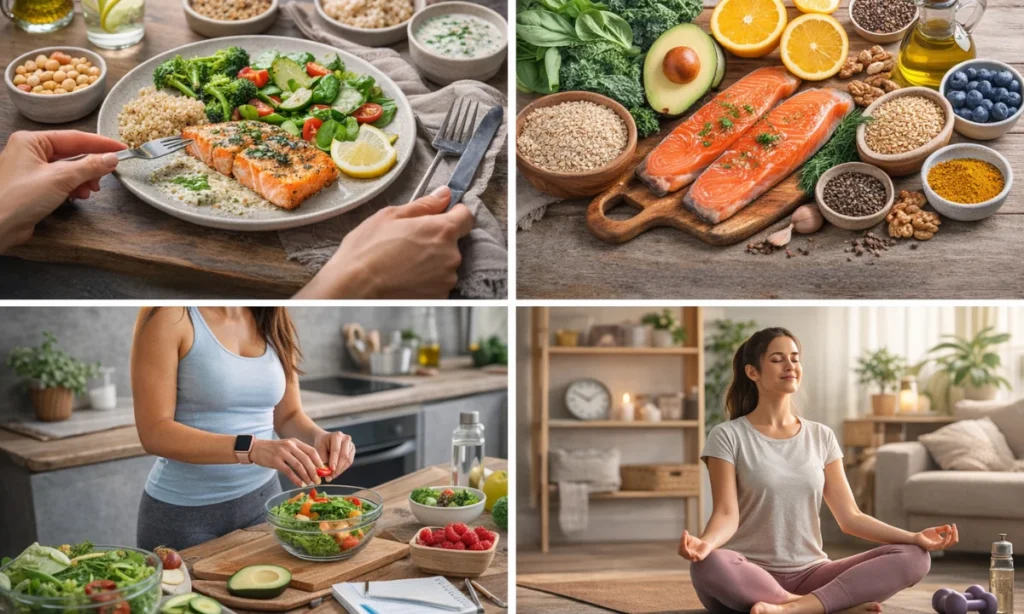
How to Build a PCOS-Friendly Weight-Loss Plate
A simple way to structure meals is to give attention to four components.
1. Protein
Include a protein source in your main meals.
Vegetarian options include:
- Dal
- Chana
- Rajma
- Moong
- Soy chunks
- Tofu
- Paneer
- Greek yogurt/curd
- Milk
- Sprouts
Non-vegetarian options include:
- Eggs
- Chicken
- Fish
- Lean meat
Protein can make meals more filling and helps support muscle maintenance.
2. Vegetables
Aim to include vegetables regularly rather than relying on one “superfood.”
Good choices include:
- Beans
- Carrot
- Cucumber
- Tomato
- Spinach
- Methi
- Cauliflower
- Cabbage
- Bottle gourd
- Ridge gourd
- Brinjal
- Capsicum
- Broccoli
3. High-Fibre Carbohydrates
Carbohydrates do not need to disappear from a PCOS diet.
Better choices can include:
- Oats
- Brown rice
- Hand-pounded rice
- Millets
- Whole-wheat roti
- Whole grains
- Beans
- Lentils
- Fruits
The important factor is still the overall portion and meal composition.
4. Healthy Fats
Small amounts of calorie-dense foods can fit into a healthy diet:
- Almonds
- Walnuts
- Peanuts
- Seeds
- Sesame
- Flaxseed
- Chia seeds
Healthy fats are nutritious, but portion size matters because fats are calorie-dense.
7-Day PCOS Diet Plan for Weight Loss
The following is a general example, not an individualized medical diet. Portion sizes should be adjusted according to your body size, activity level, dietary preferences and nutritional requirements.
Day 1
Breakfast
2 vegetable moong dal chillas + curd
Mid-Morning
1 fruit such as guava, apple or orange
Lunch
2 chapatis + dal + mixed vegetable sabzi + cucumber salad
Evening Snack
Roasted chana + unsweetened tea
Dinner
Tofu/paneer vegetable stir-fry + 1–2 chapatis
Day 2
Breakfast
Vegetable oats upma + boiled egg or curd
Mid-Morning
A small portion of fruit
Lunch
Moderate portion of rice + rajma + vegetable salad + curd
Evening Snack
Buttermilk + roasted peanuts in a controlled portion
Dinner
Vegetable soup + grilled chicken/tofu/paneer + vegetables
Day 3
Breakfast
2 vegetable dosas + sambar
Mid-Morning
Guava or orange
Lunch
2 chapatis + chana masala + vegetable sabzi + salad
Evening Snack
Curd with a small amount of nuts/seeds
Dinner
Moong dal khichdi with vegetables + curd
The important point here is that dosa and rice are not automatically “bad PCOS foods.”
The overall meal, quantity and frequency matter.
Day 4
Breakfast
Vegetable omelette + 1–2 whole-wheat toast/roti
Vegetarian alternative: Besan chilla + curd
Mid-Morning
1 fruit
Lunch
Brown rice or regular rice in a controlled portion + dal + vegetables + curd
Evening Snack
Roasted chana or sprouts
Dinner
Paneer/tofu/chicken salad bowl + vegetables + 1 small roti
Day 5
Breakfast
Ragi dosa + sambar
Mid-Morning
Apple or guava
Lunch
2 chapatis + dal + vegetable sabzi + curd
Evening Snack
Buttermilk + small handful of nuts
Dinner
Vegetable soup + tofu/paneer/chicken + sautéed vegetables
Ragi can be a nutritious whole-grain option, but it should not be treated as a magical PCOS or weight-loss food.
Portion still matters.
Day 6
Breakfast
Vegetable poha + curd
Mid-Morning
1 fruit
Lunch
Rice + sambar + vegetable poriyal + curd
Evening Snack
Sprouts chaat
Dinner
2 chapatis + paneer/tofu/chicken + large serving of vegetables
Day 7
Breakfast
Idli + sambar + vegetable side
Mid-Morning
Fruit
Lunch
2 chapatis + dal + mixed vegetables + curd
Evening Snack
Roasted chana or unsweetened tea with a protein-rich snack
Dinner
Vegetable khichdi + curd + salad
You do not need to eat completely different foods every day.
Repeating simple meals that you enjoy can actually make a diet easier to maintain.
Foods to Eat More Often With PCOS
Instead of focusing only on foods to avoid, build your diet around foods that provide protein, fibre and nutrients.
Protein-rich foods
Vegetarian
- Dal
- Moong
- Chana
- Rajma
- Soy
- Tofu
- Paneer
- Curd
- Greek yogurt
- Milk
- Sprouts
Non-vegetarian
- Eggs
- Chicken
- Fish
- Lean meat
Fibre-rich foods
Include:
- Vegetables
- Whole grains
- Lentils
- Beans
- Fruits
- Nuts
- Seeds
Fibre can help make meals more filling and can make it easier to manage overall food intake.
Fruits
You do not generally need to eliminate fruit because of PCOS.
Practical options include:
- Guava
- Apple
- Orange
- Papaya
- Berries
- Pear
- Kiwi
- Pomegranate
Whole fruit is generally more useful than fruit juice because it retains its fibre and requires more chewing.
Foods to Limit for PCOS Weight Loss
There is no requirement to completely ban individual foods.
However, foods that are easy to overeat and provide large amounts of calories with relatively little satiety are worth limiting.
These include:
- Sugary drinks
- Sweetened tea or coffee
- Soft drinks
- Frequent sweets
- Cakes
- Biscuits
- Deep-fried snacks
- Chips
- Large amounts of bakery foods
- Fast food
- Frequent fried meals
- Large portions of calorie-dense snacks
Do You Need to Stop Eating Rice if You Have PCOS?
No.
This is one of the most common misconceptions.
Rice can be included in a PCOS diet.
The bigger issue is usually the portion and what accompanies the rice.
Compare:
Meal A
Large plate of white rice + little protein + few vegetables
with:
Meal B
Moderate rice portion + dal + vegetables + curd + salad
Both contain rice, but their overall nutritional composition is different.
You do not need to turn rice into a forbidden food to lose weight.
Can You Eat Roti With PCOS?
Yes.
Whole-wheat roti can be part of a balanced PCOS meal.
The same principle applies:
Portion + protein + vegetables + overall calorie intake
matter more than simply labeling roti as a “PCOS food” or “non-PCOS food.”
What About Millets for PCOS?
Millets can be nutritious whole grains and can be included as part of a varied diet.
Examples include:
- Ragi
- Foxtail millet
- Little millet
- Kodo millet
- Pearl millet
But don’t make the mistake of assuming:
Millet = unlimited weight loss food.
Millets still provide calories and carbohydrates.
Replacing rice with a large portion of millet does not automatically create a calorie deficit.
Do You Need a Low-Carb Diet for PCOS?
Not necessarily.
The international guideline does not identify one specific diet composition as superior for PCOS outcomes. Sustainable eating tailored to the individual’s preferences and goals is recommended.
Some women may prefer a lower-carbohydrate eating pattern because it helps them control portions or hunger.
Others may find a moderate-carbohydrate diet much easier to maintain.
The better diet is often the one you can follow consistently while meeting your nutritional needs.
A More Useful Way to Think About PCOS and Weight Loss
One of the biggest mistakes is assuming that PCOS requires a completely different weight-loss mechanism.
The guideline notes that structured, intensive and ongoing healthy lifestyle support appears to be equally effective in PCOS as in the general population.
This does not mean PCOS is easy.
Some women experience greater challenges with weight management and may have underlying factors that make maintaining or losing weight more difficult.
The practical lesson is:
Don’t give up simply because weight loss is slower than expected.
Instead, look at the entire system:
- Food intake
- Portions
- Protein
- Fibre
- Physical activity
- Sleep
- Stress
- Consistency
- Medications and other medical factors
Exercise and PCOS Weight Loss
Diet is only one part of the picture.
The international guideline recommends physical activity for women with PCOS and notes that there is not enough evidence that one particular type or intensity of exercise is universally superior.
For general health, adults are advised to aim for 150–300 minutes of moderate-intensity activity per week or 75–150 minutes of vigorous activity, along with muscle-strengthening activity on two non-consecutive days.
For greater benefits including modest weight loss and prevention of weight regain, the guideline notes a target of around 250 minutes of moderate activity per week or 150 minutes of vigorous activity, plus muscle strengthening.
You can divide activity across the week.
For someone starting from a sedentary lifestyle, even increasing activity gradually can be more realistic than immediately attempting an intense exercise program.
The PCOS Weight-Loss Mistakes That Can Backfire
1. Eating Too Little
Severely restricting food may make the diet difficult to sustain.
A sustainable calorie deficit is generally more practical than extreme restriction.
2. Eliminating All Carbohydrates
There is no need to completely eliminate carbohydrates to manage PCOS.
3. Depending on “PCOS Superfoods”
No single food can fix PCOS.
Chia seeds, cinnamon, ragi, berries or other popular foods can be part of a healthy diet, but they should not replace an overall balanced eating pattern.
4. Drinking Calories Without Realizing It
Sugary drinks, sweetened coffee, milkshakes and frequent juices can add substantial calories without creating the same fullness as a whole-food meal.
5. Focusing Only on the Scale
Weight is one useful measurement, but it is not the only one.
The PCOS guideline emphasizes benefits of healthy lifestyle changes even in the absence of weight loss.
Changes in waist circumference, fitness, metabolic health, eating habits and overall wellbeing can also matter.
How Long Does It Take to Lose Weight With PCOS?
There is no reliable universal timeline.
Your rate of weight change depends on:
- Starting body weight
- Food intake
- Activity
- Sleep
- Age
- Medications
- Medical conditions
- Consistency
- Individual energy requirements
Avoid promises such as “lose 10 kg in 30 days with this PCOS diet.”
A more realistic goal is to develop eating and activity habits that can continue for months and years.
What If You Are Not Losing Weight?
Don’t immediately conclude that your diet has “failed.”
Review the basics first:
Check your portions
Healthy food can still provide too many calories when portions are large.
Check liquid calories
Tea, coffee, juice, soft drinks and shakes can add up.
Check cooking oil
Oil is calorie-dense, so the amount used in curries and frying matters.
Check snacks
Small snacks throughout the day can quietly increase total intake.
Check activity
Long periods of sitting can reduce total daily energy expenditure.
Check consistency
Following a diet strictly for two days and then overeating on the weekend can reduce the weekly calorie deficit.
If weight management remains difficult, discuss it with a qualified healthcare professional rather than repeatedly switching between extreme diets.
Can PCOS Be Managed Without Losing Weight?
Yes.
This is an important point that is often lost in weight-loss-focused PCOS content.
The 2023 guideline states that healthy lifestyle behaviours have benefits even when weight loss does not occur.
Lifestyle management can support:
- General health
- Physical fitness
- Body composition
- Metabolic health
- Quality of life
- Prevention of further weight gain
Weight loss may be an appropriate goal for some women, but it should not be the only measure of progress.
Simple PCOS Diet Rules You Can Actually Follow
Instead of memorizing a huge list of “PCOS foods,” use these practical rules:
Rule 1
Include a protein source in your main meals.
Rule 2
Include vegetables regularly.
Rule 3
Choose whole or minimally processed carbohydrate sources more often.
Rule 4
Keep sugary drinks and frequent fried foods limited.
Rule 5
Control portions of calorie-dense foods.
Rule 6
Do not automatically eliminate rice, roti or fruit.
Rule 7
Choose a diet you can realistically maintain.
Rule 8
Combine healthy eating with regular physical activity.
Rule 9
Track progress over weeks and months rather than judging your diet from one day’s weight.
Rule 10
Get individualized medical or dietetic advice when PCOS symptoms, medications, pregnancy plans or other health conditions affect your nutritional needs.
Frequently Asked Questions
What is the best diet for PCOS weight loss?
There is no single diet proven to be best for every woman with PCOS. The 2023 international guideline recommends sustainable healthy eating tailored to individual preferences, nutritional needs and goals.
Can I eat rice if I have PCOS?
Yes. Rice can be included in a balanced PCOS diet. Portion size and the overall composition of the meal matter.
Can I eat fruit with PCOS?
Yes. Whole fruit can be part of a healthy diet. There is generally no need to eliminate fruit solely because you have PCOS.
Is a low-carb diet necessary for PCOS?
No. Current international guidance does not support one specific diet composition as universally superior for PCOS.
Are millets good for PCOS?
Millets can be nutritious whole grains and can be included in a varied diet. However, they are not a magic treatment for PCOS and still contribute calories and carbohydrates.
How many calories should I eat for PCOS weight loss?
There is no universal calorie target. The PCOS guideline recommends a tailored energy deficit when weight loss is appropriate, taking individual energy requirements, body weight and physical activity into account.
Can exercise help with PCOS?
Yes. Physical activity is an important part of PCOS lifestyle management. The guideline recommends sustainable physical activity based on individual preferences and goals.
Do I need to avoid sugar completely?
Not necessarily. A more practical approach is to limit foods and drinks high in added sugar, particularly those that make it easy to consume excess calories.
Can I follow this 7-day plan every week?
The plan can be used as an example, but repeating exactly the same meals indefinitely is not necessary. Variety helps you obtain different nutrients and makes the diet more flexible.
Final Takeaway
A PCOS weight-loss dietician does not need to be extreme.
You do not have to completely remove rice, roti, fruit or carbohydrates.
The more sustainable strategy is to build meals around protein, vegetables, fibre-rich foods and appropriate portions, while limiting foods that make it easy to consume excess calories.
Most importantly, there is no single diet composition that has been proven to work best for every woman with PCOS. The international evidence-based guideline recommends sustainable eating and physical activity tailored to individual needs and preferences.
If weight loss is your goal, focus on a plan you can follow consistently rather than searching for the next “PCOS miracle diet.”
A sustainable diet that fits your culture, food preferences, budget and lifestyle is more useful than a perfect diet that you cannot maintain.
Medical note: This article provides general nutrition information and is not a substitute for individualized medical or dietetic advice. Women with PCOS who are pregnant, trying to conceive, taking medication, have diabetes or other medical conditions, or have a history of disordered eating should seek personalized guidance from an appropriately qualified healthcare professional.